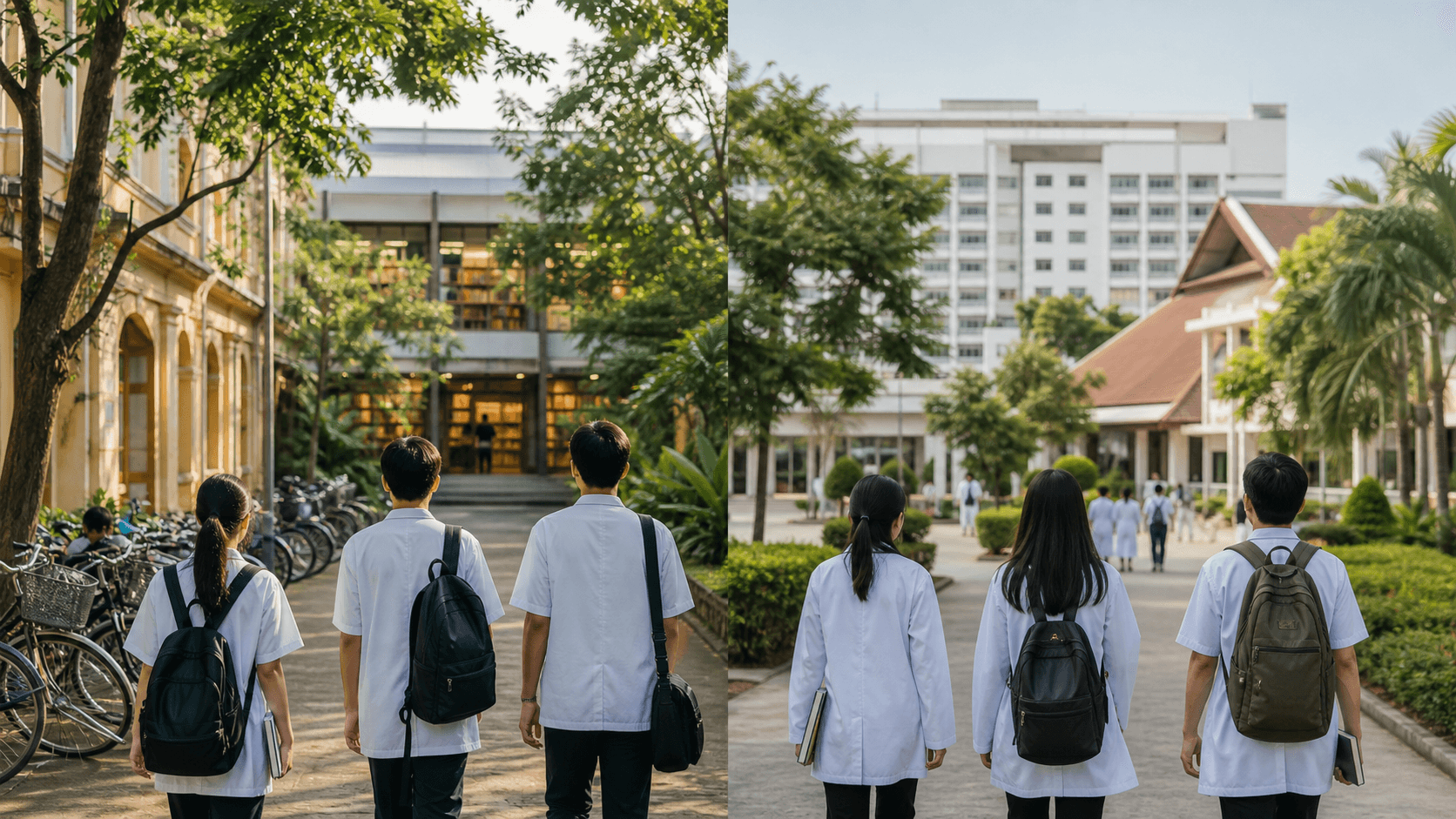



For most Indian parents, the useful answer is not “Vietnam is better” or “China is better”. The better question is: which exact university can document the full medical course, clinical training, language arrangements, host-country authorisation and India-side licensing pathway?
Vietnam’s current Indian-facing partner network is a smaller, defined shortlist with university-specific fees and cities. China has a much larger higher-education system, but English-taught clinical medicine is controlled through approved institutions and annual plans. That makes programme-level verification particularly important.
Vietnam vs China at a glance
| Decision point | Vietnam | China |
|---|---|---|
| Shortlisting | Seven partner universities on this site, each with its own criteria | Large national system; identify the exact approved medical university and intake |
| Course shape | Partner data describes six-year medical routes; verify each offer | China’s Ministry of Education quality provisions describe a six-year English-taught undergraduate clinical medicine programme |
| Tuition | Current site snapshot is about $4,100-$8,214 a year, depending on university and schedule | University-specific; obtain the current fee, hostel, insurance, deposit and refund schedule |
| Academic language | English-medium scope must be confirmed by university and clinical phase | English-taught academic programme does not remove the need to check Chinese language and patient communication |
| Clinical training | Ask for named hospitals, rotation dates, supervision and internship documents | Ask for affiliated hospitals, clinical language, authorised intake and the full practical component |
| India licensing | Verify WDOMS, host-country recognition and current NMC rules | The same checks apply, plus evidence that the English-taught programme is authorised for the intake |
| Immigration | Follow the university’s invitation/residence process and the official immigration portal | Confirm the current student-visa route and university-issued documents directly with the institution and official authorities |
This table is a decision map, not a ranking. A strong answer from one university is more valuable than a country-level assumption.
1. Fees: compare the whole route
The Vietnam snapshot on this site places six-year tuition across the seven partner universities at approximately $24,606-$39,350, before hostel and other costs. The range is wide: Dai Nam is listed at about $4,100 flat tuition a year, while the public and metropolitan options use different schedules. See the Vietnam fees page and the university directory for the current starting point.
China should not be described as one price. Tuition, hostel, insurance, registration, deposits, medical checks and other charges vary by university. A family should ask for a six-year schedule or at least the full first-year invoice and the renewal method. A low first-year quote can be misleading if later years, hostel, clinical training or internship costs are not shown.
Use one spreadsheet with these columns:
- annual tuition and what the university calls the degree;
- hostel, deposit, utilities and meal arrangement;
- insurance, registration and student-service charges;
- visa, residence, medical check and document costs;
- flights, local transport and personal living budget;
- clinical or internship costs and the final graduation documents;
- refund rules if admission, visa or residence is not completed.
The Vietnam cost-of-living guide explains how to build the non-tuition side without hiding one-time expenses.
2. English medium is a document, not a slogan
China’s Ministry of Education quality-control provisions state that English-taught undergraduate clinical medicine programmes are subject to quality controls and describe a six-year course. The Ministry also publishes approved institution and enrolment-plan notices. Its 2023-24 notice says that institutions not included in the approved list may not recruit international students into the English-taught undergraduate clinical medicine programme or issue the English MBBS degree described there.
That is a useful protection for parents: request the exact current official list or notice, the university’s authorised intake, the programme name and the documents that match the offer. Do not accept “all classes in English” as sufficient evidence.
Vietnam also requires university-level checking. Ask whether basic sciences, clinical subjects, patient-facing teaching, examinations and internship are all covered in English, and how much Vietnamese is required for hospital communication. The NMC FMGL FAQ identifies English as the medium requirement in the cited FMGL explanation; the current legal rules and later notices should be checked for the student’s admission year.
3. Clinical language can matter more than classroom language
A student may understand an English lecture and still struggle to take a history from a local patient. China’s official provisions explicitly make Chinese a compulsory course throughout the English-taught undergraduate medical programme and connect language learning with student life and patient contact. That does not tell us how much clinical communication an individual university provides; it tells us what to ask.
For either country, request:
- the language used during bedside teaching and clinical notes;
- the number and location of affiliated hospitals;
- the start of clinical rotations and weekly timetable;
- the supervision model and assessment method;
- any language examination or patient-communication requirement;
- the internship location, duration and completion certificate.
If the answer is vague, treat the uncertainty as a decision risk rather than assuming it will be solved after arrival.
4. Recognition: four checks, not one badge
Parents often ask whether a country is “NMC recognised”. That is an incomplete question. Check the exact school and programme in WDOMS, confirm host-country institutional and programme status, read the current NMC FMGL material, and verify that the course itself delivers the required duration, medium, theory, practical and clinical training.
WDOMS is a directory and should not be treated as a standalone endorsement. Likewise, a university’s claim that it is internationally popular does not prove eligibility for Indian registration. Keep the written evidence in the student’s file and ask what happens if a programme changes its name, campus, language or affiliated hospital.
5. Student support, climate and distance
Vietnam’s partner cities are in a tropical or subtropical setting and are generally closer to the Indian student support routes used by this site. China spans a much larger geography, so climate, airport access, travel time and language environment vary substantially by university. These are not merely lifestyle details: they affect food, clothing, family visits, transport and the student’s ability to ask for help.
Ask the university who handles:
- airport pickup and first-week orientation;
- residence registration and visa extensions;
- medical care and emergency escalation;
- hostel allocation and room changes;
- translation support for hospitals and official offices;
- contact with Indian parents during an emergency.
The admission-process guide is useful for understanding the documentation sequence, but the receiving university must confirm its own process.
6. Immigration and document control
For Vietnam, use the official National Immigration Portal and follow the university’s written invitation or guarantee instructions. The portal explains the conditions for e-visa holders and notes that a new visa may involve an inviting or guaranteeing organisation. Do not pay a third party for a “special student visa” without seeing the university and government documents.
For China, ask the university which admission notice and foreign-student visa documents it issues, the correct student-visa category, the medical examination requirements and the residence-registration steps after arrival. Confirm the process with the university and the relevant official Chinese mission or authority for the student’s location. Visa approval is not academic recognition, and academic admission is not a guarantee of visa approval.
A parent decision checklist
Choose Vietnam or China only after the exact university answers these questions in writing:
- Is the legal institution and exact medical programme clear?
- Is the programme present in the applicable host-country authorisation or intake list?
- Is WDOMS information available for the exact school?
- Are all academic, clinical and internship phases documented?
- What is the language of lectures, examinations, patient contact and records?
- What is the full six-year fee and refund schedule?
- What are hostel, residence, insurance and travel costs?
- Which documents will the student receive at graduation?
- Has the family checked the latest NMC rules for the admission year?
If you want help comparing a student’s marks, budget and preferred country, use the site’s existing contact route or WhatsApp counselling flow. Ask for a written university-specific checklist and invoice; a country brochure should be the beginning of the conversation, not the final evidence.
Limitations note — checked 24 July 2026
Chinese approved lists, university fees, quotas, visa procedures and hospital arrangements can change by academic year. Vietnam fees, hostel capacity, immigration steps and university arrangements can also change. This article intentionally avoids a country-wide ranking and unverifiable pass-rate claims. Re-check the exact programme with the university, WDOMS, the host-country authority, the official visa channel and the latest NMC regulations before any payment.