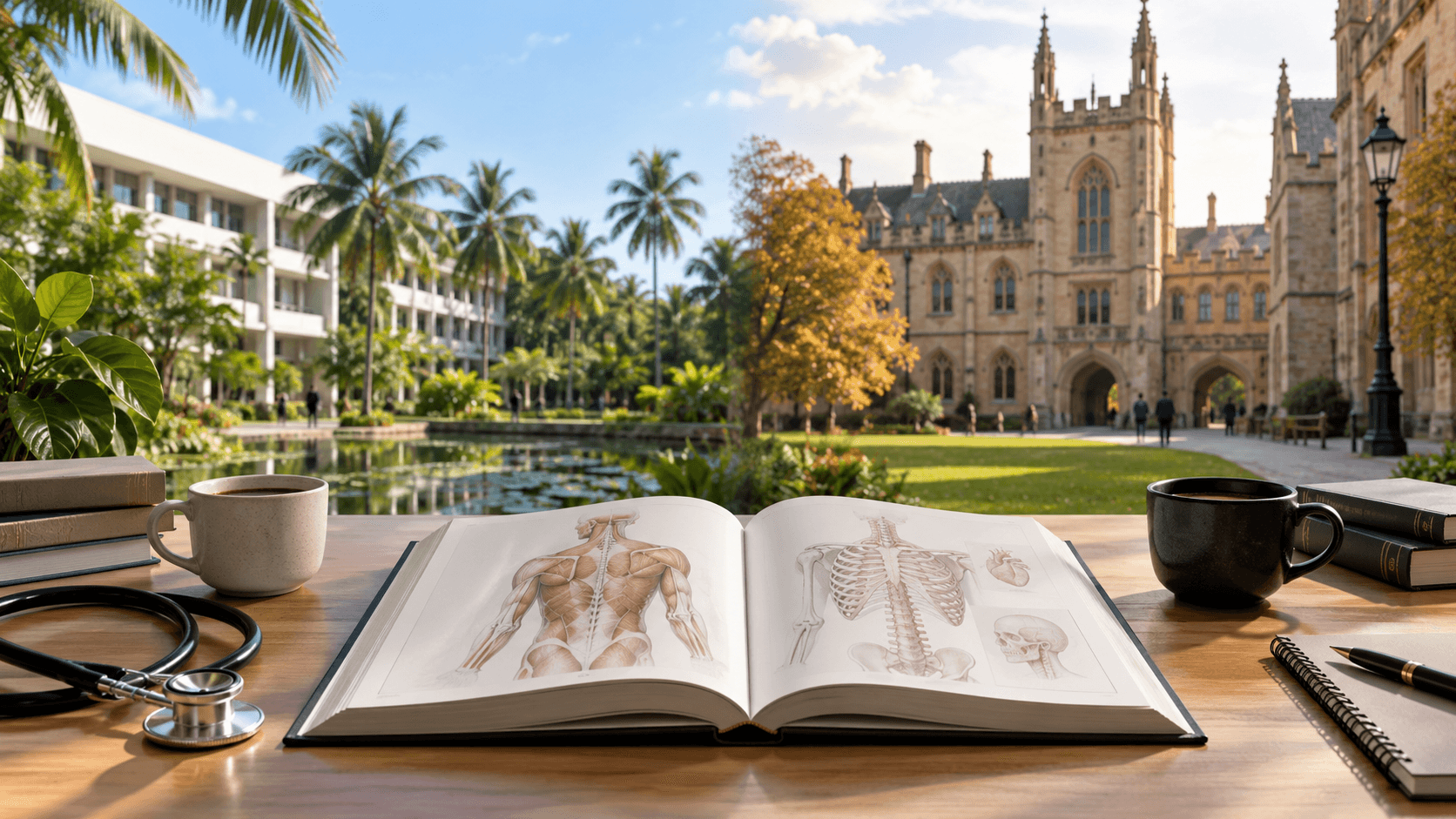



For most Indian families, Vietnam is the more straightforward route to investigate when a partner university offers a direct post-Class-12 application and a clearly documented programme. Mexico can be academically attractive, but it is not a simple country-wide alternative: Spanish-language ability, institution-specific admissions, local recognition and the longer administrative distance from India deserve serious weight.
This is a screening comparison, not a claim that either country is automatically suitable. Read it with the site's MBBS in Vietnam shortlist guide, English-medium and clinical-language guide and university verification checklist.
Vietnam and Mexico at a glance
| Decision point | Vietnam | Mexico |
|---|---|---|
| Entry after Class 12 | Available at some universities under their own criteria; NEET treatment is university-specific | Faculty-specific admission; entrance tests, prerequisites and Spanish requirements may apply |
| Teaching language | Some programmes describe classroom teaching as English-medium; verify clinical Vietnamese | Spanish is central to most medical education and patient care; verify any English provision |
| Course shape | Many Indian-facing routes are structured as six-year medical programmes | Medical degree structure varies by institution and may include university-specific clinical and social-service requirements |
| Budget | Use the site's university fee pages and a written six-year estimate | Public/private fees and city costs vary widely; obtain an official international-student quote |
| Visa | University-supported student route must be checked for the exact intake | Mexico's official guidance covers a temporary resident student visa for stays over 180 days |
| India pathway | Check current NMC FMGL requirements and exact university evidence | Check the same NMC requirements plus the Mexican programme's degree and clinical documentation |
The table shows why “cheapest country” is a weak decision rule. Language, clinical access, travel, documents, exchange rates and the probability of completing the programme matter as much as tuition.
Admission and academic fit
Vietnam's Indian-facing universities may assess Class 12 science marks, passport records, health documents and other university-specific material. Dai Nam University is an important example in the site's university data because it requires a valid NEET qualifying score at admission; other partner routes must be checked individually. A family should never generalise one university's NEET policy to the whole country.
Mexico does not offer one universal “MBBS admission” route for foreign applicants. A student must identify the faculty, degree title, campus and intake. Ask for the international admissions page, prerequisites, entrance exam, Spanish-language evidence, transcript evaluation and whether foreign school records need an equivalence or revalidation process.
The parent decision is therefore partly about execution risk. A direct written offer from a Vietnamese university may be easier to understand than a Mexican process that requires several local steps, but the Vietnamese offer still needs independent verification of degree, medium and clinical training.
Language is the largest practical difference
English-medium claims need detail in both destinations. For Vietnam, ask whether English applies to lectures, slides, question papers, vivas, lab instructions, clinical records and patient interaction. Clinical Vietnamese may still be important when students enter wards and communicate with patients.
For Mexico, Spanish is not a small add-on. Patients, nurses, supervisors, case notes and public-health placements may operate in Spanish. A student who has studied science in English can still struggle to take a history or understand a rapid clinical handover. Ask for the faculty's language policy and the expected Spanish level before paying an application or deposit fee.
Cost: compare a complete route
Build two budgets with the same headings:
- tuition and mandatory academic charges;
- hostel or rent and utilities;
- food, local transport and health cover;
- visa, residence, document and translation costs;
- flights and family visits;
- exam, internship and graduation charges;
- currency-conversion and bank-transfer costs; and
- a contingency for one delayed semester.
Vietnam's published partner data gives families a starting range, but the final invoice controls. For Mexico, do not use a public-university headline fee as a proxy for an international applicant's actual cost. Ask whether the quote includes laboratory charges, registration, clinical insurance, social-service requirements and non-refundable deposits.
Clinical training and licensing due diligence
A medical degree is only as useful as the training and licensing pathway it supports. Obtain the curriculum, clinical-year schedule, named hospitals or sites, supervision model, patient-contact language and internship or social-service requirements.
For Vietnam, ask the university to document how clinical hours are recorded, where students train and what appears on the final transcript. For Mexico, clarify whether the programme includes social service, how it is assigned, whether an international student can complete it under the same conditions and which authority issues the final professional documents.
Then review the current NMC FMGL FAQ and FMGL rules listing. NMC compliance is not created by a consultant's label, a directory entry or a country's reputation. Check the exact batch and university before admission and preserve all evidence through graduation.
Visa, distance and family support
Mexico's official temporary resident student visa guidance describes a route for foreign students accepted by an eligible institution, with financial evidence and a process through a Mexican consular office. The official information also notes the need for the post-arrival residence-card process. Confirm current consular instructions, costs and timelines before booking flights.
Vietnam also requires the exact university sponsorship and residence process to be confirmed. Use the site's student visa and residence guide for questions to put in writing.
Distance changes the support model. India-to-Vietnam travel is generally more manageable for family visits than India-to-Mexico travel, but this should not become a safety guarantee. Ask about airport pickup, emergency contacts, hostel rules, health insurance, local transport and who supports a student outside office hours.
Parent decision checklist
Before choosing either country, obtain these documents from the named university:
- official offer naming the degree, campus and intake;
- full fee schedule and refund policy;
- admission criteria and language requirements;
- semester-by-semester curriculum;
- clinical sites, hours, supervision and internship or social-service rules;
- student visa and residence instructions;
- accommodation, insurance and emergency-support details; and
- a written answer on how the programme maps to the student's current NMC due diligence.
If a family cannot get these answers from the university itself, pause the payment. A counselling team can organise a question list and compare offers, but it cannot convert an uncertain programme into a guaranteed Indian licence.
For a file-specific conversation, use the site's contact route or WhatsApp counselling flow.
Bottom line
Vietnam is usually easier for an Indian family to shortlist when the university provides a direct, documented Class 12 route and a clear support structure. Mexico deserves consideration only when the student is ready for Spanish-led clinical communication and the selected faculty provides a transparent international admissions and documentation pathway. In both cases, select the university and programme first, then complete NMC, clinical, fee and visa checks.
Limitations note — checked 1 September 2026
Admissions, fees, exchange rates, visa rules, language policies, clinical placements, degree requirements and NMC guidance can change. Mexico's visa and revalidation information is institution- and authority-specific; Vietnam's programme and fee details are university-specific. Reconfirm current written documents, the exact intake and the applicable Indian rules before payment.